
Connecting together : Innovation to perfection
ADVANCED DISCOVERY BIOLOGY
...
Exploring molecular binding with real-time insights. Discover affinity, kinetics and interaction characteristics through Surface Plasmon Resonance analysis.
Surface Plasmon Resonance (SPR) is a label-free analytical technique used to investigate molecular interactions in real time. It provides valuable information about how biomolecules and potential therapeutic compounds interact with their targets.
At F-Gene LLP, our SPR assay capabilities support the characterization of biomolecular binding events, helping researchers understand interaction strength, binding kinetics and molecular recognition.
By examining interactions as they occur, SPR can contribute meaningful evidence to target validation, lead characterization and early-stage drug discovery.

SPR provides multiple layers of information about molecular interactions, helping researchers move beyond simple binding observations.
Evaluate the strength of interaction between a target molecule and its binding partner through equilibrium dissociation constants (KD).
Investigate how quickly two molecular partners associate and form a binding complex (ka).
Understand how quickly molecular complexes separate, providing insights into interaction stability (kd).
Examine binding behaviour over time to characterize the dynamics of molecular interactions.
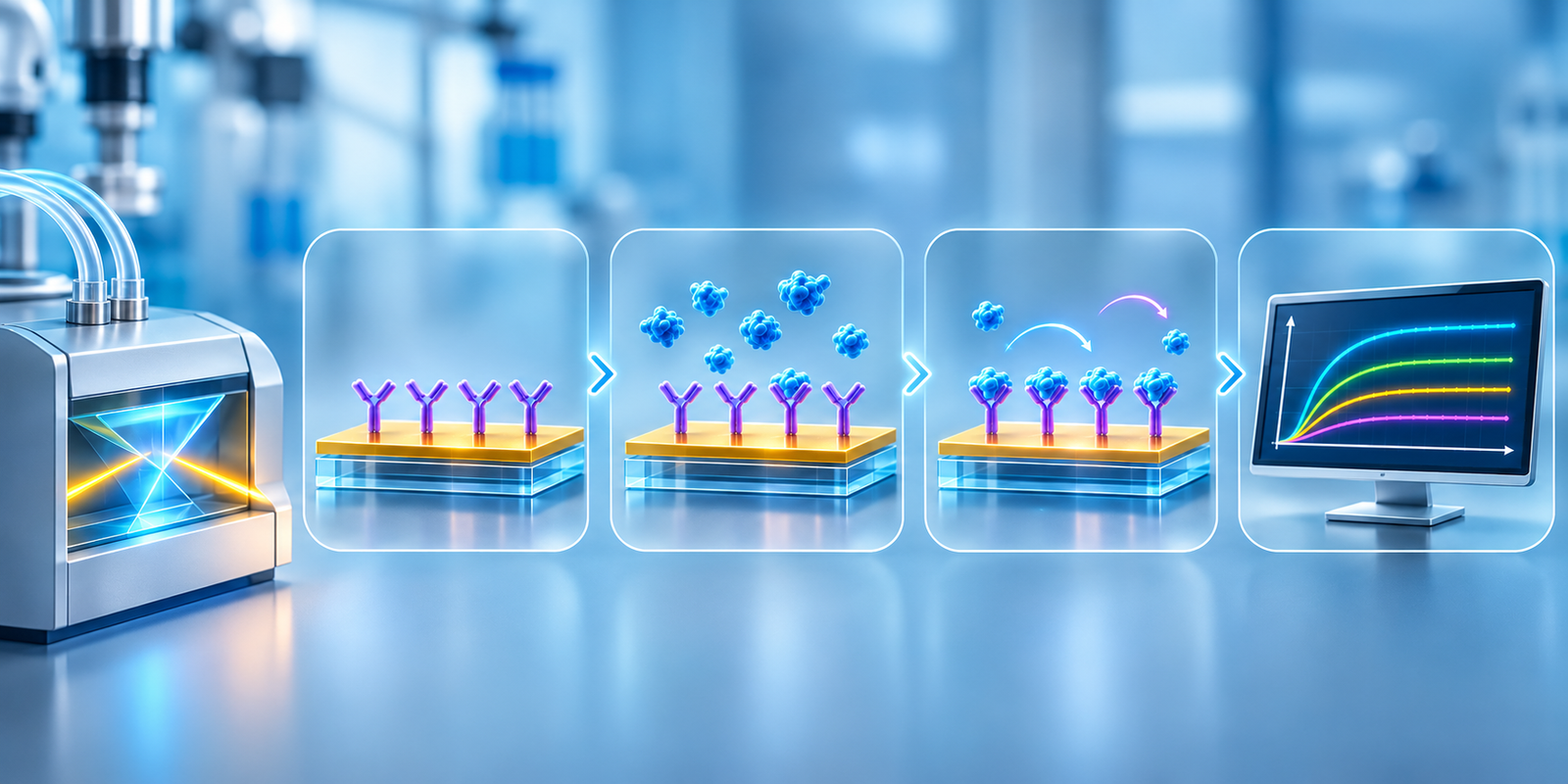
SPR measures changes in the refractive index near a sensor surface as molecules interact. These changes generate a response signal that can be monitored throughout the binding process.
A selected target molecule is attached to a specialized sensor surface.
The potential binding partner is introduced over the sensor surface at selected concentrations.
Molecular association and dissociation events are recorded as response changes.
Sensorgrams are evaluated to understand binding affinity and kinetic parameters.
SPR sensorgram analysis provides quantitative parameters that help characterize the interaction between a target and its binding partner.
Describes the rate at which an analyte binds to an immobilized target molecule, reflecting the speed of complex formation.
Measures the rate at which a bound molecular complex separates, providing insight into binding stability.
Represents the equilibrium binding affinity and is derived from the ratio of dissociation and association rate constants in a 1:1 model.
Flexible SPR-based experimental support for investigating biomolecular interactions and understanding target-binding behaviour.
Characterization of interactions between proteins and their biological binding partners to investigate molecular recognition.
Investigation of small molecule interactions with selected protein targets to support compound characterization.
Assessment of binding behaviour between antibodies and their corresponding antigens.
Evaluation of molecular binding strength through analysis of equilibrium affinity parameters.
Analysis of association and dissociation rates to understand the kinetics of molecular interactions.
Comparison of molecular binding profiles across selected molecules or experimental conditions.
Understanding how molecules interact is an important part of evaluating therapeutic candidates. SPR-based studies can provide complementary evidence across different stages of early research.
Investigate specific molecular interactions to support the evaluation of potential therapeutic targets.
Examine the binding properties of selected compounds during early-stage drug discovery.
Understand antibody-antigen binding behaviour and compare interaction profiles.
Study the binding characteristics of selected biological molecules and molecular partners.
Every research project begins with understanding the scientific question and defining an appropriate experimental strategy.
Define the target, analyte and research requirements of the project.
Establish a suitable assay strategy and experimental conditions.
Evaluate molecular binding and generate interaction response data.
Analyse experimental findings and communicate relevant binding parameters.
Partner with F-Gene LLP for customized SPR assay support and molecular interaction characterization. Let's discuss your research requirements.